
Key Takeaways
- Collagen synthesis requires controlled thermal stimulation. By reaching specific temperature thresholds in the dermis, these treatments trigger a healing response that builds new structural support and improves skin elasticity over time.
- Treatment depth must be customised to facial structure. HIFU targets deeper layers like the SMAS at higher temperatures, while Radiofrequency is typically better for individuals with less subcutaneous fat to prevent unintended volume loss.
- Non-surgical tightening has specific clinical limits. These modalities are highly effective for skin texture remodelling and mild laxity, but they function as a preventative or subtle corrective measure rather than a replacement for surgery in cases of significant sagging.
Ageing is a universal process, but the way it shows up on our faces can vary widely. Interestingly, up to 90% of visible skin ageing is linked to sun exposure, while genetics accounts for a smaller proportion. Over time, the body gradually loses structural support: collagen production begins to decline after the mid-20s at a rate of roughly 1% per year. This loss affects not only the skin but also cartilage and bone.
As collagen and elastin decrease, several visible changes occur. Fine lines and wrinkles become more noticeable, facial fat pads begin to descend, and skin gradually loses its firmness. At the same time, repeated facial expressions strengthen certain muscles—particularly depressor muscles—which can contribute to widening of the lower face and the development of jowls.
These changes are why non-surgical skin tightening treatments have become increasingly popular. Two of the most widely used technologies are High-Intensity Focused Ultrasound (HIFU) and Radiofrequency (RF) treatments. Both aim to stimulate collagen production through controlled heating of the skin, but they work in different ways and suit different individuals.
How Skin Tightening Treatments Work
Most non-surgical tightening treatments rely on a similar biological principle: controlled heat stimulation.
When heat is delivered to the dermis (the deeper layer of skin), it creates tiny zones of thermal injury called thermal coagulation zones. This process causes proteins such as collagen, elastin, and other extracellular matrix components to contract and triggers the body’s natural healing response. Over time, this response leads to the formation of new collagen and structural support, improving skin firmness and elasticity.
A key concept in these treatments is “time at temperature.” Tissues must reach the right temperature and remain there long enough to stimulate a biological response. A simple analogy is briefly passing your finger through a candle flame—you feel heat, but because the exposure is so short, the skin doesn’t burn.
If energy penetrates deeply enough into the subcutaneous fat layer, fat cells may also be affected. This is why some treatments can lead to fat reduction, which can be beneficial in areas such as the jowls or under the chin. However, this must be carefully controlled because excessive energy can cause unwanted fat loss.
Importantly, while these technologies can improve mild to moderate skin laxity, they cannot replace surgery when there is significant excess skin or advanced sagging.
How High-Intensity Focused Ultrasound (HIFU) Works
HIFU works by delivering focused ultrasound energy to specific depths beneath the skin. The ultrasound beams converge at precise points, creating small thermal injury zones in the dermis and the SMAS layer (the same structural layer targeted during surgical facelifts).
Temperatures in these focal points can reach around 70°C, which is why patients often feel brief prickling or heat sensations during treatment.
HIFU is generally best suited for individuals with mild to moderate skin laxity. Treatment can be customised to target multiple depths depending on the person’s skin thickness and facial structure.
Key considerations include:
• Thin individuals may require more superficial treatments to avoid fat loss.
• Moderate soft-tissue thickness often responds best to multi-layer treatments targeting both dermis and SMAS.
• While some fat reduction may occur, HIFU is not primarily designed for targeted fat removal.
For precise fat removal, liposuction remains the gold standard, although it is a surgical procedure and requires careful consideration.
How Non-Invasive Radiofrequency (RF) Works
Radiofrequency treatments use electrical energy to generate heat within the skin.
There are two main types:
Monopolar RF
Electric current travels from the treatment electrode through the body to a grounding pad. This configuration allows for deeper tissue penetration, sometimes up to around 20 mm, though most treatments remain relatively superficial.
Bipolar RF
The current flows between two electrodes within the device itself. This limits penetration depth, typically to 2–4 mm, making it more focused on the dermis.
Most RF treatments maintain skin temperatures around 42–45°C, which is lower than HIFU. Because the temperature is lower, the heat must be applied for a longer time to achieve collagen stimulation. Patients usually remain awake and can provide feedback if the treatment becomes too hot, which improves safety.
RF treatments are often better suited for thinner individuals, as the lower temperatures reduce the likelihood of unwanted fat loss.
How RF Microneedling Works
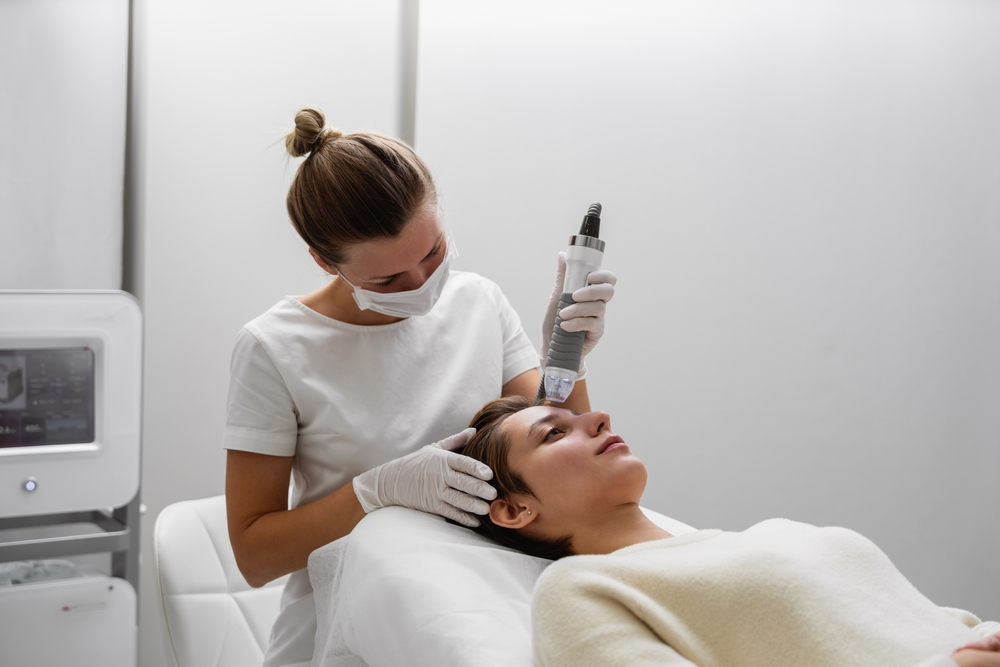
Radiofrequency microneedling combines microneedles with RF energy to deliver heat directly into the skin.
The needles can penetrate anywhere from 0.5 mm to 7 mm, allowing energy to be delivered precisely at different depths. Many devices use insulated needles, which release energy only at the tip to protect the skin surface and reduce the risk of pigmentation issues.
RF microneedling is particularly effective for:
• Skin tightening
• Acne scar improvement
• Pore reduction
• Skin texture remodeling
However, because the treatment penetrates deeper layers, it is more invasive and typically more uncomfortable, often requiring numbing or pain management. Careful patient selection is essential, particularly for individuals with darker skin tones who may be prone to post-inflammatory hyperpigmentation (PIH).
Shape Clinic for HIFU, RF Skin Tightening, or RF Microneedling
Determining the most appropriate treatment depends on individual skin thickness, laxity, and clinical goals. At Shape Clinic, a comprehensive assessment identifies whether Ultraformer HIFU
or Radiofrequency Microneedling is best suited to your unique facial structure. Contact Shape Clinic today to book a consultation with our clinical team.